WebSec-Guardian
Marauder is an ESP32 based defensive cybersecurity prototype developed to educate students and ethical hackers about how wireless threats can be detected and mitigated safely. It passively monitors Wi-Fi and Bluetooth signals to demonstrate threat awareness not exploitation helping learners understand how attacks like deauthentication, spoofing, and rogue access points occur and how to secure against them. All offensive functions (jamming, spamming, impersonation) are explicitly disabled, making this a 100% legal, educational, and defensive device. The project aims to promote ethical cybersecurity awareness at hackathons and college tech events. Built using: ESP32-DevKitC-32UE, TFT LCD Touch Display, LiPo Battery, TP4056 Charger, Rocker Switch, Wi-Fi/Bluetooth Antenna, and custom 3D-printed casing. Purpose: To help students see, not attack — a visual, real-time way to study wireless behavior and improve security understanding.
Created by
 Code With Mehru
Tier 5
23 views
0 followers
 CAN ⚡🚀
requested changes for WebSec-Guardian ago
CAN ⚡🚀
requested changes for WebSec-Guardian ago
You need photos in your readme and journal
Tier: 5
Code With Mehru
submitted WebSec-Guardian for ship review ago
Code With Mehru
added to the journal ago
WebSec Guardian
Day 7 (Logging & data format)
Created CSV/JSON log schema for SD and HTTP upload. Example entry: ts,ssid,bssid,rssi,chan,gps_lat,gps_lng.
Wrote logger pseudo-code and SD rotation policy (max file size, daily logs).
Planned secure upload: HTTPS + token-based auth (no plaintext). Time spent: 16 hours
Day 8 (Safety, ethics, and documentation)
Expanded README safety section; explicitly marked all offensive features as DISABLED.
Wrote testing policy: only test on owned/permissioned networks, record consent.
Added image disclaimer in README and updated journal. Time spent: 8 hours
Day 9 (UI/UX: display & alerts)
Designed on-screen UI for TFT: status bar, top N SSIDs, RSSI bar graph, alert banner.
Decided buzzer behavior for passive alert thresholds (short beep for new unknown AP, longer for suspicious spike).
Sketched CLI commands for querying logs and setting thresholds. Time spent: 15 hours
Day 10 (Roadmap, testing plan & next steps)
Compiled final roadmap: purchase parts, assemble prototype, run controlled tests, publish firmware v0.1.
Created test plan (lab tests, field tests, consent forms) and checklist for submission.
Prepared files to push to repo (firmware skeleton, BOM, wiring, journal).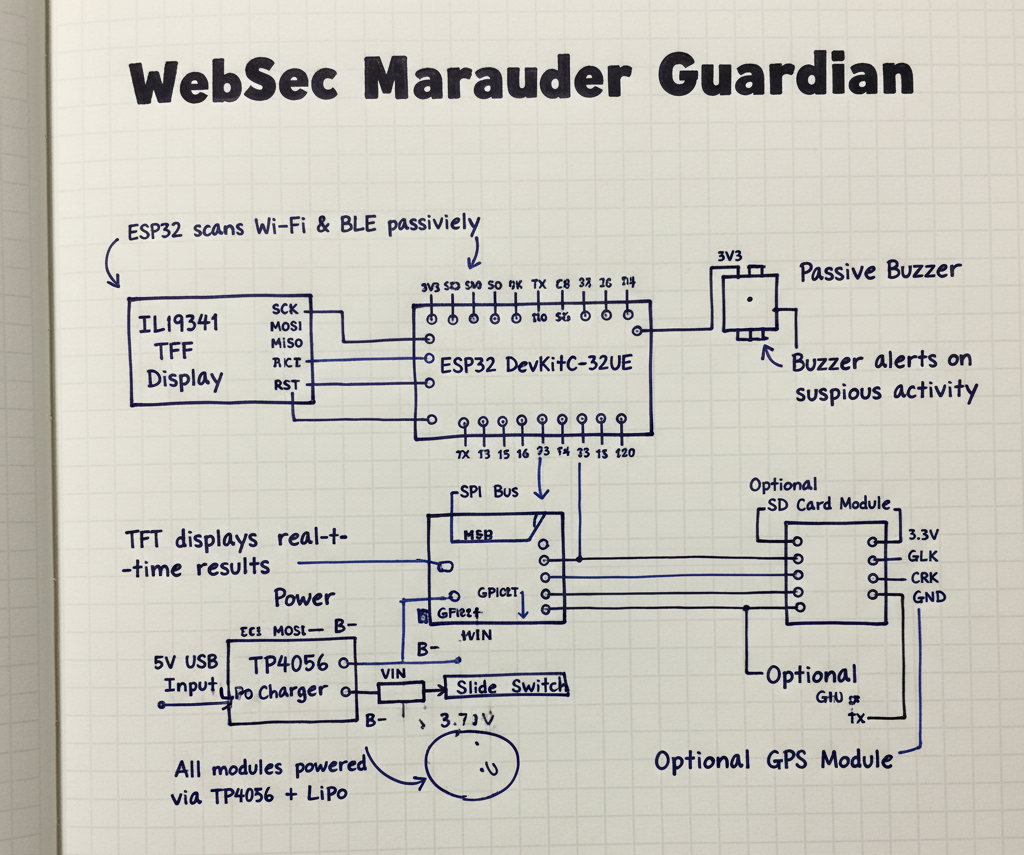
Code With Mehru
added to the journal ago
WebSec Guardian
Day 4 (Wiring diagrams & prototyping plan)
Drew wiring-diagram.png showing connections: ESP32 SPI → TFT, TP4056 → LiPo, buzzer, switch, SD module.
Added notes on pin choices, voltage rails, JST connector recommendations, and safety.
Planned breadboard test steps and required tools (soldering, JST crimp). Time spent: 10 hours
Day 5 (Firmware architecture & module design)
Designed firmware modular structure: wifiscanner, btscanner, display, logger, gps, ota.
Wrote API/CLI plan for logging format and HTTP upload schema (fields: timestamp, ssid, bssid, rssi, channel, gps).
Prepared PlatformIO/Arduino structure and dependencies list. Time spent: 23 hours
Day 6 (Passive scanning experiments)
Ran local experiments with ESP32 example sketches (WiFi.scanNetworks, BLEScanner) on devboard I have (or simulated).
Measured timings and power draw; recorded sample outputs and filtered noisy SSIDs.
Determined appropriate scan interval (tradeoff between battery and detection latency).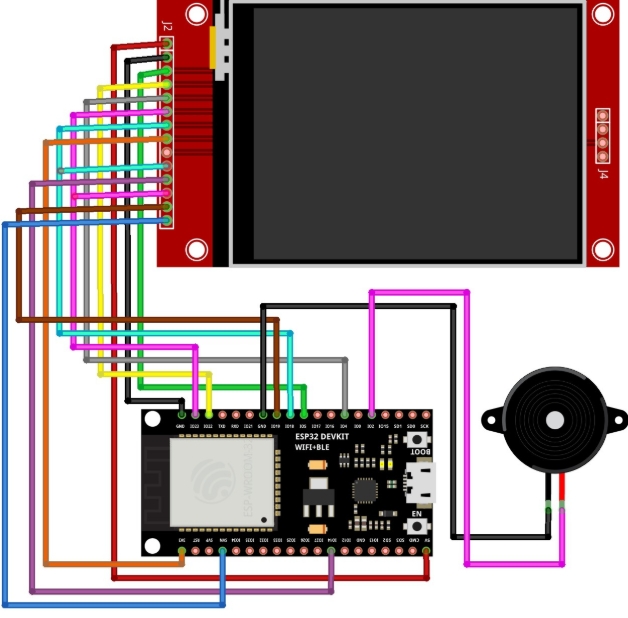
Code With Mehru
added to the journal ago
WebSec Guardian
Day 1 (Project kickoff & research)
Researched defensive vs offensive Wi-Fi tools and legal/ethical considerations.
Collected references on passive Wi-Fi scanning, BLE sniffing, and signal analysis.
Decided to keep project strictly 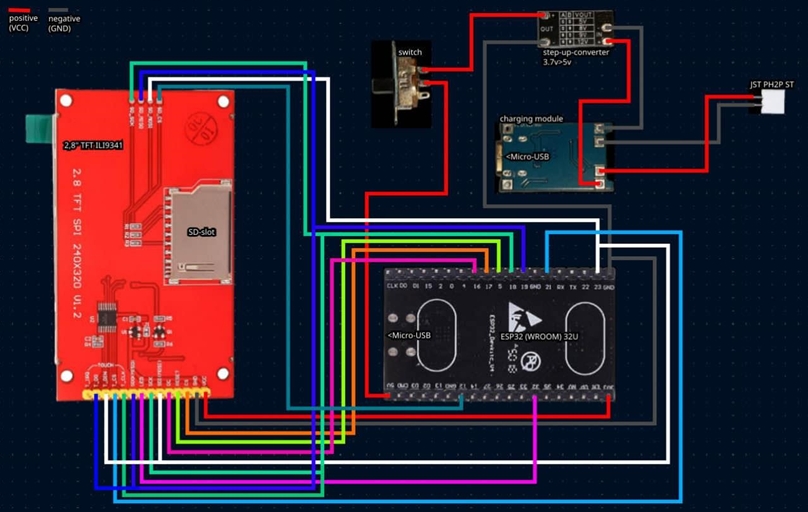
passive and educational; documented ethics in README.
Created initial project outline, scope, and success criteria. Time spent: 12 hours
Day 2 (BOM & parts selection)
Surveyed vendors (Amazon, Robu) for ESP32 boards, TFT displays, LiPo, chargers, antenna, buzzer.
Compiled BOM.csv and optimized costs; added notes on parts I already own vs planned purchases.
Chose ESP32-DevKitC-32UE for BLE + Wi-Fi dual support and ILI9341 TFT for visualization. Time spent: 10 hours
Day 3 (Mechanical design & 3D case)
Modeled case layout concept (dimensions, mounting points) in Fusion360 / CAD.
Exported STL for front/back case and iterated on fastening points and ventilation.
Rendered a prototype image for repo documentation (placeholder image used).
Code With Mehru
started WebSec-Guardian ago
11/4/2025 9:09 AM - WebSec Guardian
Day 1 (Project kickoff & research)
Researched defensive vs offensive Wi-Fi tools and legal/ethical considerations.
Collected references on passive Wi-Fi scanning, BLE sniffing, and signal analysis.
Decided to keep project strictly 
passive and educational; documented ethics in README.
Created initial project outline, scope, and success criteria. Time spent: 12 hours
Day 2 (BOM & parts selection)
Surveyed vendors (Amazon, Robu) for ESP32 boards, TFT displays, LiPo, chargers, antenna, buzzer.
Compiled BOM.csv and optimized costs; added notes on parts I already own vs planned purchases.
Chose ESP32-DevKitC-32UE for BLE + Wi-Fi dual support and ILI9341 TFT for visualization. Time spent: 10 hours
Day 3 (Mechanical design & 3D case)
Modeled case layout concept (dimensions, mounting points) in Fusion360 / CAD.
Exported STL for front/back case and iterated on fastening points and ventilation.
Rendered a prototype image for repo documentation (placeholder image used).
11/4/2025 9:10 AM - WebSec Guardian
Day 4 (Wiring diagrams & prototyping plan)
Drew wiring-diagram.png showing connections: ESP32 SPI → TFT, TP4056 → LiPo, buzzer, switch, SD module.
Added notes on pin choices, voltage rails, JST connector recommendations, and safety.
Planned breadboard test steps and required tools (soldering, JST crimp). Time spent: 10 hours
Day 5 (Firmware architecture & module design)
Designed firmware modular structure: wifiscanner, btscanner, display, logger, gps, ota.
Wrote API/CLI plan for logging format and HTTP upload schema (fields: timestamp, ssid, bssid, rssi, channel, gps).
Prepared PlatformIO/Arduino structure and dependencies list. Time spent: 23 hours
Day 6 (Passive scanning experiments)
Ran local experiments with ESP32 example sketches (WiFi.scanNetworks, BLEScanner) on devboard I have (or simulated).
Measured timings and power draw; recorded sample outputs and filtered noisy SSIDs.
Determined appropriate scan interval (tradeoff between battery and detection latency).
11/4/2025 9:11 AM - WebSec Guardian
Day 7 (Logging & data format)
Created CSV/JSON log schema for SD and HTTP upload. Example entry: ts,ssid,bssid,rssi,chan,gps_lat,gps_lng.
Wrote logger pseudo-code and SD rotation policy (max file size, daily logs).
Planned secure upload: HTTPS + token-based auth (no plaintext). Time spent: 16 hours
Day 8 (Safety, ethics, and documentation)
Expanded README safety section; explicitly marked all offensive features as DISABLED.
Wrote testing policy: only test on owned/permissioned networks, record consent.
Added image disclaimer in README and updated journal. Time spent: 8 hours
Day 9 (UI/UX: display & alerts)
Designed on-screen UI for TFT: status bar, top N SSIDs, RSSI bar graph, alert banner.
Decided buzzer behavior for passive alert thresholds (short beep for new unknown AP, longer for suspicious spike).
Sketched CLI commands for querying logs and setting thresholds. Time spent: 15 hours
Day 10 (Roadmap, testing plan & next steps)
Compiled final roadmap: purchase parts, assemble prototype, run controlled tests, publish firmware v0.1.
Created test plan (lab tests, field tests, consent forms) and checklist for submission.
Prepared files to push to repo (firmware skeleton, BOM, wiring, journal).